In his recent remarks in the US, #RahulGandhi has spoken about the importance of rebuilding India’s manufacturing sector, the inability of a services-led economy to generate sufficient employment for our vast population, and the need for India to become a genuine production powerhouse rather than merely a market for other countries. I couldn’t help going back to 2003, when my father, Dr. Malay Chaudhuri, and I wrote The Great Indian Dream — a book launched by none other than his mother, #SoniaGandhi! Twenty-three years ago, we had already made a compelling case for why India needed to protect, strengthen and develop its manufacturing capabilities. We explained how, until 1973, it was the manufacturing sector that had helped make the American Dream a reality, and how, subsequently, as America brought down its tariff barriers and its manufacturing industries came under increasing pressure from international competition, particularly from Japan, the foundations of its manufacturing ...
WE WROTE ABOUT THE IMPORTANCE OF MANUFACTURING IN 2003. SONIA GANDHI LAUNCHED THE BOOK. IN 2026, FINALLY, IT IS RAHUL GANDHI WHO IS TALKING ABOUT IT!
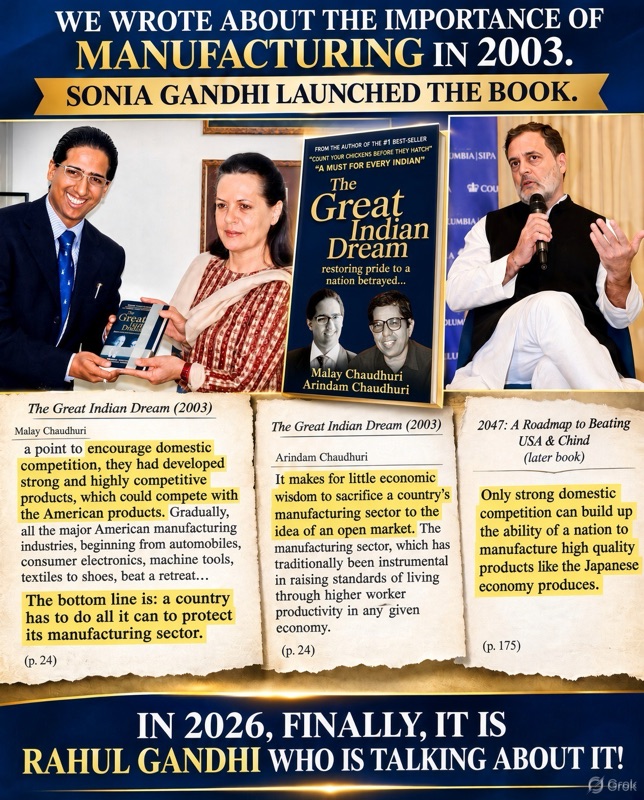
In his recent remarks in the US, #RahulGandhi has spoken about the importance of rebuilding India’s manufacturing sector, the inability of a services-led economy to generate sufficient employment for our vast population, and the need for India to become a genuine production powerhouse rather than merely a market for other countries.
I couldn’t help going back to 2003, when my father, Dr. Malay Chaudhuri, and I wrote The Great Indian Dream — a book launched by none other than his mother, #SoniaGandhi!
Twenty-three years ago, we had already made a compelling case for why India needed to protect, strengthen and develop its manufacturing capabilities. We explained how, until 1973, it was the manufacturing sector that had helped make the American Dream a reality, and how, subsequently, as America brought down its tariff barriers and its manufacturing industries came under increasing pressure from international competition, particularly from Japan, the foundations of its manufacturing strength began to erode.
We elaborated:
“The bottom line is: a country has to do all it can to protect its manufacturing sector.”
We went on to explain how Japan had built globally competitive products by encouraging domestic competition and developing its own industrial capabilities.
We also wrote:
“It makes for little economic wisdom to sacrifice a country’s manufacturing sector to the idea of an open market.”
Our argument, however, was not simply about protectionism. It was about building Indian capabilities, encouraging indigenous manufacturers, developing globally competitive products and ensuring that India captured a fair share of the profits generated by its enormous domestic market.
I returned to this theme, with an even stronger focus on China, Japan, innovation and industrial competitiveness, in my subsequent book, 2047: A Roadmap to Beating USA & China (2022), which I again co-authored with my father Dr. Malay Chaudhuri, posthumously.
In that book, I argued:
“Only strong domestic competition can build up the ability of a nation to manufacture high quality products like the Japanese economy produces.”
And I raised a question that remains just as relevant today:
“How could we allow other companies to come in and capture our markets when we should have been making the profits out of our huge markets and capturing world markets?”
I also wrote about how China moved from adopting foreign technologies and competing through price and manufacturing efficiency to developing its own globally respected brands and technological innovations.
The point is simple.
India cannot become a truly developed economic power merely by consuming what the world produces. Nor can it generate sufficient meaningful employment for its people by relying disproportionately on services.
We need manufacturing. We need indigenous enterprise. We need technological innovation. We need globally competitive Indian brands.
And above all, we need a national economic vision that looks beyond political slogans and electoral cycles.
I am glad that manufacturing is receiving renewed political attention. But it is worth remembering that these ideas were being articulated at the IIPM Think Tank and put into our books decades ago.
The Great Indian Dream (2003)
2047: A Roadmap to Beating USA & China (2022)
Sometimes, the most satisfying thing about an idea is not that people eventually start talking about it, but that you had the conviction to write about it long before they did.
I will end by reminding all, of the decades old punchline at IIPM:
WHAT WE TEACH TODAY, OTHERS ADOPT TOMORROW
#DareToThinkBeyond with #ArindamChaudhuri
IIPM #IIPM #IIPMTHINKTANK
#TheGreatIndianDream
Link to the FREE PDFs of both the books
https://www.abillionleaders.com/arindam-books.html.
Comments